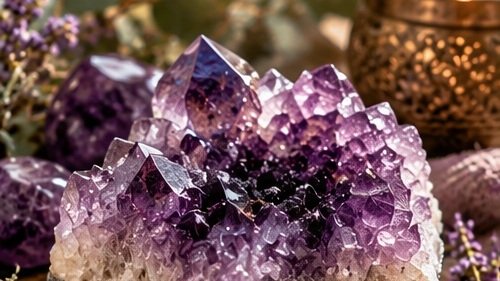
Have you ever wandered into a crystal shop intending to have a quick look, only to find yourself still there half an hour later? Perhaps it was the soft music, the shelves crowded with curious treasures, or the way the light caught a cluster of purple crystals and made it sparkle like a tiny cave full of stars. Amethyst has that sort of charm. Some pieces are the palest lavender, almost shy about their colour, while others are a deep, velvety violet. You might find a smooth little stone that fits perfectly in your palm, or a great hollow geode with hundreds of glittering points tucked inside. Either way, it’s easy to understand why people have been fascinated by amethyst for such a long time.
In crystal traditions, amethyst is often spoken of as a companion for intuition, peaceful energy and spiritual connection. It’s a favourite for meditation corners, bedside tables and those quiet moments when we want to turn down the noise of the day. You don’t have to know anything about chakras or crystal healing to appreciate it, though. Curiosity is a perfectly good place to begin.
A little Earth magic
Before we wander into the mystical side of amethyst, there’s something rather wonderful about the stone itself. Amethyst is the purple variety of quartz, a mineral made of silicon dioxide. Its colour is linked to traces of iron within the crystal and the effects of natural irradiation over geological time. Nature really does have a flair for the dramatic. Amethyst forms in different settings, including cavities in volcanic rock, where crystals can grow into clusters and geodes. Look closely at a piece and you may see the colour shifting from pale lilac to deep purple, sometimes even within the same crystal. Quartz has a hardness of 7 on the Mohs scale, which makes amethyst fairly durable, although it still deserves a little care.
You’ll hear people talk about Brazilian and Uruguayan amethyst, about crystal points and cathedral geodes, and about specimens with particularly rich colour. Those details can be fascinating if collecting becomes your thing. But don’t let anyone convince you that a small, inexpensive stone is somehow less worthy of your affection. Some of the loveliest treasures are the ones that slip into a pocket and quietly stay with us for years.
A stone with a colourful past
Amethyst has been turning heads for thousands of years. Its name comes from the ancient Greek amethystos, meaning roughly “not intoxicated”, and the Greeks and Romans associated the gem with sobriety and clear thinking. Imagine that: a purple stone with a reputation for helping people keep their wits about them. Over the centuries it appeared in jewellery, carved objects and religious ornament. Its rich colour made it a natural favourite wherever people wanted something beautiful and a little special. Today it is also known as February’s traditional birthstone. You may have heard the dramatic tale of a maiden named Amethyst, the god Dionysus and a transformation into purple stone. It’s a wonderful story, but the familiar version is a later literary invention rather than a surviving ancient Greek myth. Crystal lore is full of tales that have gathered new details along the way, and I think it’s more interesting to know where a story comes from than to lose it altogether.
What does Amethyst mean spiritually?
Now we’re getting to the part that makes many crystal lovers lean a little closer. In contemporary crystal-healing traditions, amethyst is associated with calm, intuition, spiritual awareness and clarity. Some people choose it when they want to settle into meditation. Others keep it close during journalling, energy work or moments of reflection. You’ll also hear it described as a protective stone, particularly in practices concerned with energetic boundaries and cleansing a space. There isn’t one single rulebook for working with crystals, and that’s worth remembering. Different traditions give stones different meanings, and two people can feel quite differently about the same piece of amethyst. One person might experience it as deeply meaningful in ritual; another may simply love the colour and the sense of occasion it brings to a quiet corner of the house. Neither needs to borrow the other’s experience.
For me, the loveliest way to approach crystal symbolism is as an invitation to explore. If amethyst represents clarity to you, perhaps it becomes the stone you reach for when your thoughts feel tangled. If you associate it with intuition, it might remind you to stop looking for everyone else’s answer and listen to your own inner voice for a moment.
The third eye, the crown and that beautiful violet colour
If you’ve spent any time among chakra books or crystal displays, you’ve probably seen amethyst paired with the third-eye and crown chakras. The third eye, often called Ajna, is associated with insight, perception and inner wisdom. The crown, Sahasrara, is associated with spiritual awareness and connection beyond the everyday self. In many modern crystal practices, amethyst is brought into meditation with these energy centres. Someone exploring the third eye might hold a piece while reflecting on a question they’ve been avoiding. Someone drawn to crown-chakra work may use its violet colour as a focus for contemplation, prayer or connection with the sacred, however they understand that word.
The familiar rainbow of chakra colours, including violet for the crown, belongs especially to modern interpretations; chakra traditions have developed in different ways over time. That doesn’t take anything away from a ritual that feels meaningful. It simply gives us a richer picture of the traditions we’re exploring. And you don’t need to see flashes of purple light or have a grand spiritual revelation. Sometimes a peaceful ten minutes is enough.
An Amethyst meditation
If you have an amethyst nearby, bring it along. If not, you can imagine one, or return to this practice another day. Find a place where you can sit comfortably, whether that’s a cushion on the floor, a favourite chair or a sunny spot on the verandah. Rest the crystal in your hand or somewhere you can see it. Before you close your eyes, take a good look at it. Notice the uneven edges, the tiny points, the places where the purple deepens and the places where light seems to slip right through. It’s rather lovely to think of how slowly those patterns formed beneath the Earth. Now let your attention settle on your breathing. There’s no need to take enormous breaths or make anything happen. Just notice the air coming and going, and feel the support of the chair or ground beneath you. If it feels comfortable, allow your shoulders to soften.
Imagine a gentle violet glow around the crystal, or around yourself. Think of it as a little piece of creative visualisation, not a test you need to pass. Then quietly ask, What would I like to make space for in my life right now? Allow your mind to rest in the quiet. You may have a word that comes to you, or you find yourself thinking about something entirely unexpected. Perhaps nothing comes at all. That’s fine. Let the question sit with you for a few moments without demanding an answer. When you’re ready, open your eyes and take in the room around you. You can write a few lines in a journal, or simply carry that quiet feeling into the rest of your day. A meditation doesn’t have to produce a revelation to be worthwhile. Allowing the quiet is sometimes all you need.
Rituals that find their way into the everyday
One of my favourite things about crystal traditions is how easily they can become part of ordinary life. You don’t need an altar the size of a dining table or a cupboard full of supplies. Often the smallest rituals are the ones that last. Imagine a little amethyst sitting beside your bed. Each evening, as you put down your phone and switch off the lamp, it reminds you to let the day come to an end. You might hold it for a moment and think, “Whatever hasn’t been solved today can wait until tomorrow”. Amethyst is traditionally linked with restful sleep and dreamwork, although those are spiritual associations rather than established sleep treatments. The real gift of the ritual may be the permission it gives you to unwind.
Your crystal can live on your desk or a side table. Every time you notice it, you remember to relax your jaw, drop your shoulders and look away from the screen. There’s something delightfully practical about a mystical little object becoming a reminder to care for yourself. A smooth tumbled stone can travel in a pocket, too. Before a difficult conversation or a busy afternoon, you can hold it and return to an intention you chose that morning. Not because a crystal is expected to solve the problem for you, but because it gives that intention a familiar shape and weight. If you enjoy journalling, try choosing one word for the week and keeping your amethyst beside the page. At the end of each day, jot down a moment when you noticed that quality in yourself or wished you’d remembered it. Seven little reflections can tell you quite a lot.
Cleansing your crystals?
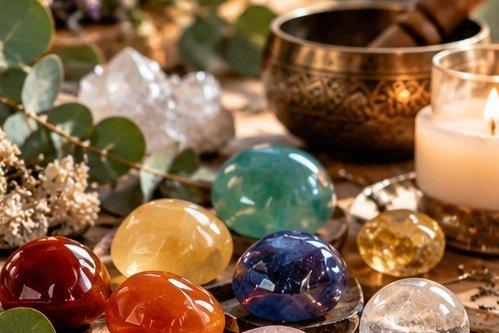
Ah, crystal cleansing. Ask a handful of crystal lovers how they do it and you’ll probably get a delightful collection of answers. Some wouldn’t dream of missing a full moon, arranging their favourite stones where the moonlight can find them. Others prefer the clear sound of a singing bowl, a moment of visualisation or simply holding a crystal and setting a fresh intention. Smoke is used in some spiritual practices, too, although it’s worth being mindful of ventilation, sensitivities and the cultural traditions associated with particular plants and ceremonies. These are spiritual rituals, not methods of physically cleaning a mineral. You can enjoy them if they speak to you, or leave them aside if they don’t. There is no universal crystal-police inspection waiting at the door.
For the practical side, a soft cloth will often do the job. Untreated amethyst can generally be cleaned gently with mild soapy water and dried well, but it’s wise to ask before washing a dyed, coated or mounted piece. Keep amethyst away from harsh chemicals, abrupt temperature changes and prolonged strong sunlight, which may alter its colour over time.
Finding a piece that feels like yours
If you’re choosing your first amethyst, give yourself the pleasure of looking around. Pick up a tumbled stone and feel how smooth it is. Look into a cluster and notice how each point catches the light differently. Stand in front of a geode and marvel at the miniature landscape tucked inside it. Points make lovely little features on shelves or meditation tables. Clusters can sparkle beautifully in natural light. Geodes are often the showstoppers, while jewellery lets you carry a favourite stone close throughout the day. None of these forms is automatically better for spiritual practice than another. A good seller should be able to tell you what you’re buying, including its size, whether it has been treated and, where known, where it came from. It’s worth asking questions rather than relying on vague promises about rarity or ethical sourcing. And if you’re buying online, look carefully at the photographs, measurements and return conditions. A close-up image can make a tiny crystal look like a mountain.
Most of all, enjoy the choosing. You may be drawn to a deep violet cluster, or you may find that a pale, slightly imperfect little stone is the one you keep coming back to. There’s no need to turn that into a grand mystery. Sometimes something is simply beautiful to us, and that’s reason enough.
When a little purple stone becomes part of your story
There’s a special kind of affection we develop for objects that have travelled through life with us. A crystal bought at a market on a happy afternoon. A stone given by a friend. A tiny amethyst that has moved from house to house, somehow always finding a place on the windowsill. Over time, those pieces can hold memories, intentions and meaning. They remind us of places we’ve been, things we’ve learned and the person we were when we first brought them home. Perhaps that’s one of the reasons amethyst has remained so loved. It offers us the wonder of the natural world, centuries of human fascination and a lovely excuse to pause for a moment and reconnect with ourselves.
So if a little purple crystal catches your eye one day, take your time. Turn it towards the light. Notice what you love about it. And if it ends up coming home with you, it may become the beginning of a beautiful new curiosity — or the latest treasure in a collection that has been growing for years. Either way, there’s always room for a little purple magic.
Wander through the library
- Chakra Stones and Personal Reflection — explore the symbolism of crystals and energy centres.
- Five-Minute Meditation — start a quiet daily practice.
- Grounding Techniques for Everyday Life — reconnect with the present moment.
Worth exploring
If amethyst has captured your imagination, you might enjoy looking at natural clusters, pocket-sized tumbled stones, illustrated mineral guides or simple accessories for a meditation corner. Look for sellers who clearly describe the actual stone, its size and any treatments.
Recommendations
This guide may direct you to Holistic Living Resources. Affiliate links are identified within the recommendation.