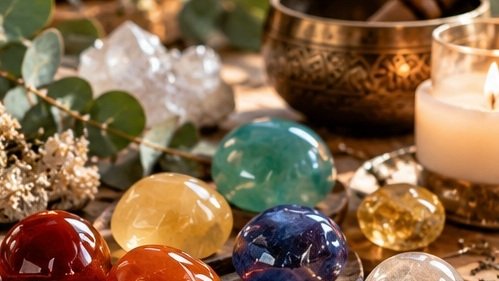
Have you ever noticed a row of seven brightly coloured stones in a crystal shop and wondered why they’re arranged from red to violet? They’re often sold as chakra stones, with each colour representing a centre in a popular contemporary chakra system. It’s a beautiful display, but there’s much more to explore here than choosing stones to match a chart. The practice offers a way to reflect on different parts of life, from feeling at home in your body to finding the confidence to speak your mind.
Where the chakra idea comes from
The word chakra comes from Sanskrit and is often translated as wheel or circle. Chakra concepts appear in Indian religious and philosophical traditions, particularly in forms of Hindu and Buddhist tantra, although the number, placement and meaning of chakras differ across texts and lineages. The familiar seven-centre rainbow chart found in many modern crystal shops is a contemporary synthesis, rather than a single unchanged ancient teaching. Knowing that doesn’t make the practice less interesting. It gives us a chance to appreciate the older traditions while understanding how today’s colour-and-crystal interpretations developed. In modern energy work, chakras are often described as centres associated with aspects of our physical, emotional and spiritual experience. Crystals are then paired with those centres through colour, symbolism and the meanings that practitioners give to particular stones. You can approach this as a spiritual practice, a reflective exercise or simply an invitation to notice which themes matter most in your life right now.
Beginning at the root
The first centre, the root chakra, is commonly associated with the base of the spine, the colour red and themes of safety, stability and belonging. Red jasper, smoky quartz and black tourmaline are frequently chosen for grounding rituals, although you’ll notice that some of the most popular grounding stones aren’t red at all. If you hold one for a moment, consider what makes you feel settled. Is it a familiar routine, time outdoors, a comfortable home or knowing who you can call when you need company? The question is far more useful than worrying whether you’ve chosen the officially correct crystal. The sacral chakra, usually linked with orange and the lower abdomen, invites reflection on creativity, pleasure and emotional expression. Carnelian is a familiar companion here, with its warm reddish-orange glow. You might ask yourself where playfulness has been missing from your week, or what you’d enjoy making simply for the pleasure of it. Moving upward, the solar plexus chakra is commonly associated with yellow, confidence, personal agency and the ability to make choices. Citrine and yellow calcite often appear in modern sets. Rather than asking whether you feel powerful enough, think of one decision you’ve made recently that was genuinely your own.
Heart, voice and understanding
At the centre of the familiar arrangement sits the heart chakra, often shown in green or pink and associated with compassion, connection and the balance between giving and receiving care. Rose quartz and green aventurine are popular choices. It’s easy to focus entirely on kindness towards others here; a more revealing question might be whether you extend that same kindness to yourself. The throat chakra, represented by blue, is linked with communication and self-expression. Blue lace agate and sodalite are often used as reminders to speak clearly and listen carefully. What is something you’ve been meaning to say, and how might you express it with honesty and consideration?
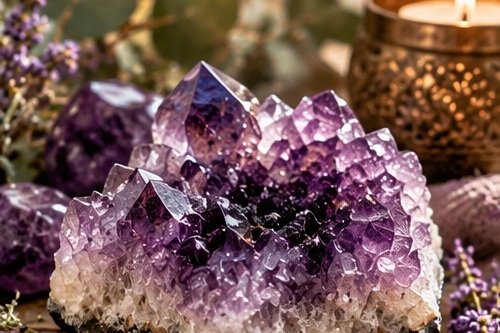
The third-eye chakra, commonly placed between the eyebrows and shown in indigo, is associated with insight, inner observation and intuition. Lapis lazuli and amethyst are frequent choices. Try reflecting on the difference between an immediate assumption and a quiet understanding that develops when you give something time. Finally, the crown chakra is usually represented by violet or white and associated with spiritual connection, meaning and our sense of belonging to something larger. Clear quartz, selenite and amethyst may appear in this part of a collection. Perhaps the question here is simply what fills you with wonder.
A little ritual with your stones
If you own a chakra set, arrange the stones in their familiar colour sequence on a table. You don’t need to lie down with crystals balanced along your body unless that’s a practice you personally enjoy. Begin with whichever stone catches your attention and spend a minute observing its colour, weight and texture. Read the theme associated with it, then ask yourself what that part of life feels like at present. You may want to write down a thought in a journal, or choose one small action that gives the reflection a place in everyday life. You can also work with a single stone for a week rather than trying to explore all seven at once. The meanings attributed to stones and chakras belong to spiritual and symbolic traditions; the stones themselves are not established treatments for physical or emotional conditions. Their value in a personal ritual can lie in the attention, imagination and intention you bring to the experience. There’s no need to purchase a perfectly matched seven-stone collection to begin. A favourite crystal, an ordinary pebble or even seven colours drawn on paper can provide a beautiful starting point.
Let the colours open a conversation
If you begin with red because stability is on your mind, but discover that the blue stone reminds you of a conversation you’ve been avoiding. Maybe the heart theme stays with you, or the crown chakra sends you back to a book on spiritual philosophy. That’s the pleasure of this kind of exploration: one small question can lead somewhere unexpected. Let the stones be a doorway into curiosity rather than a test you have to pass.
Recommendations
This guide may direct you to Holistic Living Resources. Affiliate links are identified within the recommendation.